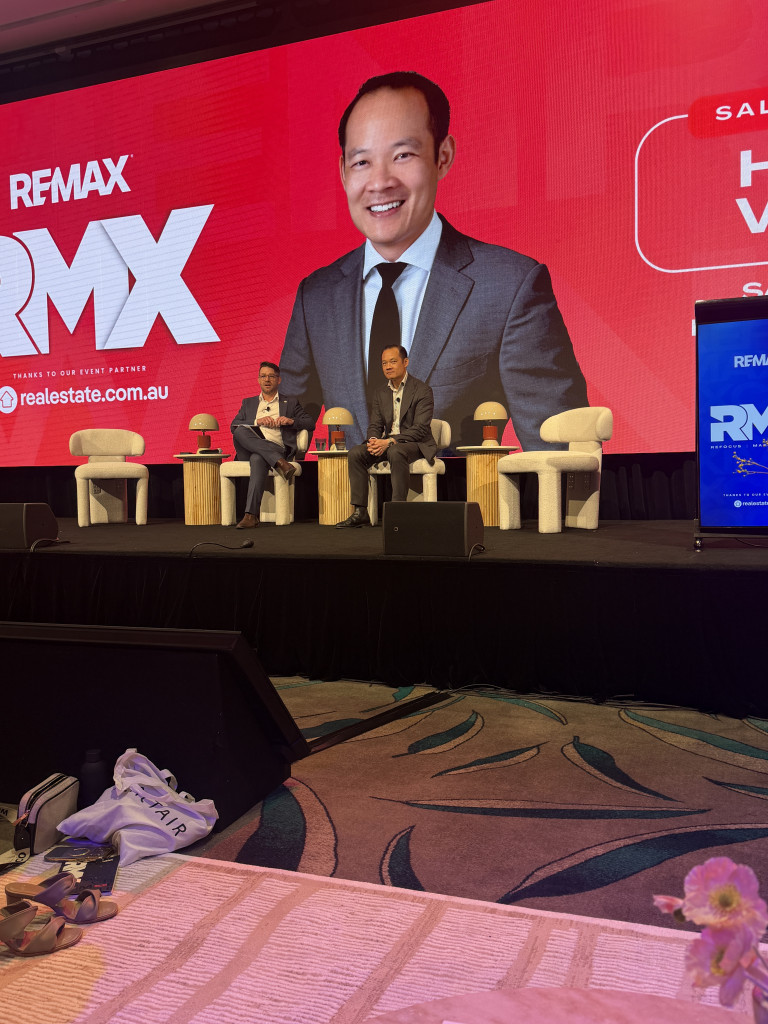
Two days. One event, #RMX26. One room full of RE/MAX agents and property managers. And one question that kept coming back: why auctions in this market?
Joel Davoren, Managing Director of RE/MAX Australia, put it to me on stage. I’m Henry Wong, RE/MAX Australia #1 Auction Agent. Then the room put it to me again.
Fair question. Especially now.
Here’s what I told them, and why auctions in this market still produce premium results for sellers who choose the right operator.
Nobody Asks Why Auctions In This Market Until Clearance Rates Are This Low
When the numbers are strong, nobody questions the method.
Right now the numbers are ugly, and Brisbane’s are the ugliest in the country.
Domain’s Brisbane auction results recorded a 27 per cent clearance rate for the week of 9 to 15 August 2026, against 48 per cent at the same point a year earlier. A fortnight later, the week of 23 to 29 August printed 22 per cent, against 51 per cent a year before.
Nationally, Cotality put the auction clearance rate at 48.9 per cent for the week ending 2 August 2026 — down 18.2 percentage points from 67.1 per cent in the same week the previous year.
This isn’t a one-month wobble. Back in June 2026, the national clearance rate fell below 50 per cent for the first time since April 2020. Cotality’s research director Tim Lawless described rates that low as rare, and said persistently weak clearance points to a mismatch between what buyers and sellers expect (Cotality data, via ABC News, 21 June 2026).
So the question is a fair one, and it’s the reason why auctions in this market are being questioned harder than at any point in years. If roughly three-quarters of Brisbane’s auctions aren’t selling on the day, why would you put yours there?
That’s what I want to answer properly — because the honest case for why auctions in this market still work has almost nothing to do with the method itself.
Most People Think An Auction Is A Day
It isn’t.
It’s a campaign.
That single misunderstanding sits behind almost every bad auction experience I hear about. A seller signs up, circles a Saturday on the calendar, and treats every day before it as a countdown to one make-or-break moment.
Then the hammer doesn’t fall, and they call it a failure.
It wasn’t a failure. It was a campaign with three possible endings, and they only ever counted one of them.
Sold Before The Auction
A buyer decides they don’t want to compete on the day. They come forward early with a strong, unconditional offer to take the property off the table before anyone else gets the chance.
That’s a win. It happens more often than most sellers expect.
Sold On Auction Day
Registered bidders. Open competition. The hammer falls.
That’s the outcome everyone pictures, and it’s the one that produces the headline result.
Sold After The Auction
The property passes in, and negotiation begins immediately — with a highest bidder already identified, a price established in the open, and every other interested buyer knowing exactly where they stand.
That’s a win too. A very common one.
A Clearance Rate Is An Average. You’re Not Hiring An Average
This is the part that gets missed every time someone quotes a clearance rate at you.
That number is a blended average across every agent who ran an auction that week. The specialist who runs auctions constantly and the agent who runs two a year go into exactly the same bucket.
If your agent is an average agent, the average number is a fair prediction of your outcome. That’s what averages do.
If they’re not, it isn’t.
Look at what’s actually inside those Queensland figures. In the week ending 9 August 2026, realestate.com.au recorded 102 pass-ins from 187 available results — more than half of every outcome — plus another 36 properties withdrawn before they ever reached the block.
Cotality put the national withdrawal rate at 19.7 per cent that month, against an average of 11.8 per cent the year before (Cotality data, August 2026).
Nearly one auction in five pulled before it ran. That statistic tells you more about why auctions in this market disappoint people than any clearance rate can.
Those aren’t auctions the market rejected. A large share are campaigns that were never built properly in the first place, then quietly withdrawn or passed in when the day arrived.
That’s a distribution of agent competence, not a verdict on the method. It’s also the single clearest reason why auctions in this market get blamed for outcomes they didn’t cause.
Ask What Your Agent’s Clearance Rate Is
Not the market’s. Theirs.
If most of an agent’s sales are auctions, and their results are strong, the market average tells you very little about what will happen to your home. You’re not buying the average. You’re buying them.
I hold the RE/MAX Australia #1 Auction Agent title with a clearance rate above 90 per cent, in a city where Domain’s weekly results have printed in the twenties.
Same method. Same city. Same month. The variable isn’t why auctions in this market succeed or fail. The variable is who’s running them.
Then Ask Where Those Results Are
This is the follow-up almost no seller thinks to ask, and it separates a genuine system from a lucky patch.
An agent with strong numbers in one pocket of one suburb may simply have a good farm area. Local reputation, a database built over years across six streets, buyers who already decided they wanted to live there.
That’s valuable. It’s also not portable. If your home sits outside that pocket, their track record doesn’t necessarily travel with it.
An agent who can show you auction results across multiple suburbs, in multiple regions, is showing you something else entirely. They’re showing you the strategy works independent of the postcode.
That’s the distinction that decides whether why auctions in this market worked for their last seller has any bearing on whether it works for you.
Because a process that only performs in one suburb isn’t a process. It’s a database. Multi-region results are the closest thing you’ll get to proof that the system travels.
The Real Answer To Why Auctions In This Market Still Work
Here’s the part most agents won’t say out loud.
The method isn’t doing the work.
An auction is a structure. A framework. It doesn’t generate buyers, it doesn’t create competition, and it doesn’t sell your home. It organises a process.
Everything that determines the result sits underneath it.
In this market, the success of an auction campaign comes down to three things: the agent’s skillset, the agent’s contacts, and the agent’s marketing.
That’s the whole answer to why auctions in this market succeed for some sellers and stall for others.
Ask ten disappointed sellers what went wrong and you’ll hear ten versions of the same story: a campaign that reached the same small pool of local buyers a private treaty listing would have reached anyway. The structure was never the problem.
Skillset
An auction campaign is three or four weeks of managed pressure.
Buyers ask questions designed to find out whether you’ll take less. Sellers wake at 3am recalculating their reserve. Feedback arrives that needs interpreting, not relaying.
An agent who can’t hold that steady starts managing the reserve down instead of managing the campaign up. That’s the difference between an agent who reports the pressure and one who absorbs it.
Contacts
Local buyers alone rarely create genuine competition. A campaign reaching only the people already searching your suburb is relying on luck.
Queensland recorded net interstate migration of 21,595 people in 2024–25, with New South Wales the largest source at around 60 per cent of the net gain — the strongest inbound flow of any state (REIQ analysis of ABS data, July 2026). Migration figures are annual, so that’s the current reading. Many of those buyers commit without ever standing in your kitchen.
Then there’s a second group most agents never reach: Australians — citizens and permanent residents — with substantial family and business interests offshore. The buyer is Australian. Much of the capital behind the purchase isn’t.
Since foreign persons were banned from buying established dwellings until 30 June 2029 (Australian Taxation Office), plenty of agents assume anything with an overseas connection is off the table. It isn’t. The framework tests who acquires the property, not where the money came from. An Australian citizen or permanent resident buying in their own name needs no approval, whatever the source of the funds.
One caveat, because it catches people out. An Australian-registered company or trust is still a foreign person if a foreign person holds 20 per cent or more of it, or two or more hold 40 per cent between them (FIRB Guidance Note 2). Incorporating here doesn’t change that. Buying through a structure is a conversation for the buyer’s lawyer before the campaign, not a surprise at settlement.
Handled properly, that’s a cash-strong, decisive buyer pool. But they only bid if someone puts the property in front of them.
An agent’s contact base isn’t a nice-to-have in a soft market. It’s the whole competitive advantage, and it’s the second reason why auctions in this market reward reach over routine.
Marketing
Marketing isn’t a listing on a portal.
Portals reach buyers already looking. That’s the easy half.
The harder half is the buyer who wasn’t looking this week — the interstate family still deciding on a suburb, the local upgrader who assumed nothing decent was coming up. That takes reach built before the campaign, not scrambled together during it.
It’s also the part sellers scrutinise least.
Four Questions To Ask About Marketing
How do you use social media to market my home? Listen for a system, not enthusiasm. Which platforms, what content, how often, and how does any of it reach someone who isn’t already searching your suburb?
How many followers do you have on Facebook, LinkedIn and Instagram? A fair question, and one plenty of agents would rather you didn’t ask. An audience built over years is reach your campaign gets on day one, free. An agent starting from a few hundred followers is spending your marketing budget introducing themselves to strangers.
Do you write? Blogs, market commentary, anything that isn’t a listing. Agents who write regularly think regularly, and the search visibility compounds for years before your campaign opens.
Google them. Their name, then their agency and your suburb. If a buyer who already knows the agent’s name can’t find them easily, consider how a buyer who doesn’t will ever find your home.
Skillset, contacts, marketing. Get all three right and why auctions in this market work is obvious. Miss one and it looks like a gamble.
Why Auctions In This Market Live Or Die On Communication
And the thing that holds all three mindsets together?
Communication.
Not enough. Not adequate.
Over-communication.
In this market, silence is the most expensive thing an agent can offer.
A seller who hasn’t heard from their agent since Tuesday fills the gap themselves. They assume the worst. They start doubting the price, the strategy, the campaign, and eventually the agent.
By auction day, they’ve talked themselves into a lower reserve — not because the market told them to, but because nobody told them anything.
Sellers don’t need constant good news. They need constant honest news. Numbers through the door. What buyers actually said. Where the price conversation sits. What happens next, and why.
Remember that withdrawal figure — nearly one in five auctions pulled before it ran. A campaign doesn’t get withdrawn because the market changed in three weeks. It gets withdrawn because a seller lost confidence, and confidence is a communication outcome.
If you’re on market right now and struggling, ask yourself an uncomfortable question: when did your agent last call you with something you didn’t have to chase?
The Questions To Ask Before You Sign Anything
If the answer to why auctions in this market work comes down to the agent, your due diligence should too.
Alongside the four marketing questions above, ask these three.
What’s your own clearance rate, and how many of your sales are auctions? An agent who runs two auctions a year is a passenger in the market average. One who runs them constantly isn’t.
Show me your auction results across different suburbs and regions. Not one street. Not one pocket. You’re testing whether they have a strategy or a postcode.
How often will I hear from you, and what will you tell me? Listen for a schedule. If they can’t tell you before the campaign, they won’t do it during it.
Seven questions. Fifteen minutes. They’re the fastest way to work out whether why auctions in this market work will apply to your home or somebody else’s. It’s the cheapest due diligence you’ll ever do on the largest asset you own.
When An Auction Isn’t The Right Call
I run auctions. I’m not going to pretend they suit every property.
If a home has a very narrow buyer pool, or genuine unresolved issues a buyer would need conditions to manage, an unconditional sale process can work against you.
An honest agent will tell you that before you sign, not after. Understanding why auctions in this market suit some homes and not others is part of the advice you’re paying for.
What This Means If You’re Selling — Or Currently Stuck
Stop asking whether auction is the right method and start asking who would be running it.
The method is identical everywhere. The execution isn’t. That gap is the whole of why auctions in this market divide sellers into two very different camps.
And if you’re sitting on a home right now that won’t move, the problem usually isn’t your price, and it usually isn’t your home.
It’s how few of the right buyers ever saw it. That’s ultimately why auctions in this market are a reach problem wearing a method’s clothing.
Where To From Here
If you’re planning a sale, or you haven’t had success selling and wondering what went wrong, I’m happy to talk it through. No pitch, no pressure.
Contact me, Henry Wong on 0412 471 588, henry@henrywong.com.au